Why do we need to know the best film cameras of the 2020s? Well, film photography is far from dead in the digital age. While it can be slow, unpredictable, expensive, and time-consuming for many photographers, film photography has a certain magical, vintage feel that all the megapixels in the world can't replicate. Its imperfections, its latitude, and its richness keep photographers young and old falling in love with film photography—and that's before we get to the wonderful, reliable machines that are the best film cameras.
There are tons of used film cameras for sale these days. Lovingly maintained and in perfect working order, they can be purchased from quality retailers like ours or from individuals. It may take a little savvy to ensure you're getting a good deal for your money, but at Camerashopbcn we guarantee that.
BEST ANALOG CAMERAS TO BUY IN 2023


Pentax K1000
A manual SLR that has become a student favorite. Type: SLR | Film format: 35 mm | Year introduced: 1976 | Availability: Used | Lens: Pentax K mount | Viewfinder: Optical TTL | Modes: Manual | User level: Beginner/Enthusiast
Olympus OM-1
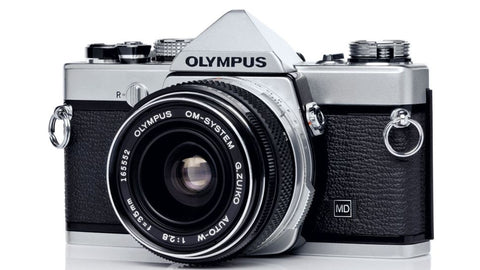
The 1970s were a golden age for 35mm SLRs, and one of the finest models of the era was the Olympus OM-1. This was a purely manual SLR, flanked by a more expensive OM-2 and a cheaper, plastic OM-10 with additional aperture-priority exposure modes. The OM-1 was designed by the same team that produced the PEN and PEN F, the models that inspired today's digital PEN models. The OM-1 was small compared to other larger, heavier SLRs of the time, but it still featured a large, bright optical viewfinder that even had interchangeable focusing screens. Unusually, shutter speed was adjusted via a ring around the lens, while a large dial on top of the camera was reserved for setting the ASA (ISO) value for the built-in light meter; this was before the introduction of DX coding on film canisters.
 ç
ç
Nikon FM2
The Nikon FM2 came out at a time when other manufacturers were releasing smaller, cheaper SLRs and new electronic controls, so it seemed like a throwback even then. But its attractive looks and reputation for longevity and durability attracted many fans and kept it in production until 2001. If you think today's Nikon Df looks good, you should pick up an FM2. It used a vertical metal shutter rather than the horizontal rubberized fabric shutters on most rival DLRs, but it was entirely mechanical, so the FM2 could operate without a battery; this was only required for the internal light meter. Its maximum shutter speed of 1/4000 sec and its tough copper, aluminum, and silicon alloy body made it sought after by professionals, not just enthusiasts.
BEST USED MEDIUM FORMAT CAMERAS

Yashica Mat 124G
Twin-lens reflex cameras use a unique dual-lens design, with the camera and its taking lens on the bottom half and a combination lens for viewing and composing photos on the top half. The viewing lens projected an image of the scene onto a frosted glass screen viewed by lifting the lid, which opened into a kind of light box. The image was inverted, which took a little getting used to, but the combination of a square image (long before Instagram!) and waist-level viewing encouraged compositions and angles you just don't 'see' with other cameras. It's a simple and reliable design that records 12 frames on 120-roll medium format film, with shallow depth-of-field effects we pay a fortune to achieve with modern cameras.

Mamiya C330
While the Yashica Mat 124G was an affordable twin-lens reflex camera with a fixed lens, the Mamiya C330 was a professional version with pairs of interchangeable lenses, introduced and popular in the 1970s as a less expensive and less complex alternative to the Hasselblad 500, THE professional medium format camera of the time. The C330 was a true system camera, with interchangeable lenses (from 55 to 250mm), interchangeable focusing screens, and a variety of viewfinders. It’s a big old lump to carry around, but you can still see film camera enthusiasts and photography students still using them today.

Hasselblad 500 C/M
Looking at the Hasselblad 500 C/M now, it’s hard to believe that this camera’s design first arrived in 1957. Its utilitarian, box-like design looks like it could have been designed yesterday, and modern high-end medium format cameras still use its flexible, modular design. The camera is the central box, into which you can fit a wide variety of lenses, several different viewfinder attachments, and different film holders. The interchangeable backs deserve a special mention: you can swap backs in moments, with your assistant loading new film into a spare back as you shoot, swap between the square 6 x 6cm or 6 x 4.5cm formats, or even clip a Polaroid in. Test the lighting and composition – this was instant (or close to it) reproduction before digital capture was invented.

Mamiya RZ67

Fuji GW690
Modern film cameras are quite specialized. They're aimed at analogue filmmakers who simply love the look and feel of film cameras, or technical specialists for whom large film formats, wide-ranging perspective-correcting camera movements, and the ability to mix and match a wide range of lenses, film stocks, and even digital backs are more important than the fast-shooting simplicity of regular digital cameras.

The Nikon F6 is like the missing link between old-school 35mm SLRs and modern digital SLR cameras. Many of its specifications will seem quite familiar to modern digital users, including its full program AE, aperture priority, shutter priority, and manual modes, motorized film advance up to 5.5 fps, and an 11-point AF system backed by Nikon's 3D Color Matrix metering system. Designed by Giugiaro, the aluminum alloy body looks like a dream, but the 5.5 fps continuous shooting speed is modest by today's DSLR standards. Nevertheless, the F6 offers the opportunity to get a beautifully designed and built, like-new film camera in working order with modern controls and technology. The Nikon F6 is available like-new in some places, but has been discontinued in many countries.
BEST CURRENT ANALOG CAMERAS

Leica MA
Leica M rangefinders will always be controversial. For some, they are overrated and overhyped throwbacks to a bygone era. For others, they are beautifully crafted engineering classics that have achieved a level of perfection. M rangefinders take a little getting used to. Rangefinder focusing is fast and accurate in the right hands, but it does require some learning, while the pain of paying for an MA body is just the beginning, because Leica lenses are equally expensive. But if you like your film photography pared down to the basics, the MA will please you. You'll need to calculate the exposure yourself, you'll need to apply the settings yourself, and you'll need to focus—but for Leica M fans, that's what being a photographer is all about.

Cambo Ultima 45 4 x 5" View Camera

Linhof Technorama 617s III
Some may remember Hasselblad's much-loved XPan panoramic camera, and some more may know the Linhof Technorama. However, unlike the XPan, the Technorama still works. The Technorama 617s III is sold body-only, but several different lenses are available. It's a camera for experts, not just because of its manual exposure, but because of the need for precise manual focusing (you don't have a through-the-lens camera) and the need to hold the camera absolutely level for those ultra-wide-angle images in a 17:6 ratio. The Technorama is designed for high-quality technical photography and showcases the flexibility that the analog film format still offers.

Toyo-View 8x10 810MII Folding Field Camera
Film cameras fall into different size categories, just as digital cameras do today. 35mm cameras were "miniature" models, believe it or not, and medium format cameras were called "medium" because there was a "large" format above that. These use sheets of film, typically measuring 5 x 4", to deliver supreme image quality. Well, almost supreme, because there's also a 10 x 8" size with four times the negative area. The Toyo-View 8x10 810MII is an example of this type of camera still made today. You'll need to source your own lens plates and lenses, track 10 x 8" film, and figure out how to carry a camera that weighs 15 pounds on its own, but with sublime image quality and a wide range of lens and camera back movements, it's a chance to follow in Ansel Adams's footsteps.
LOMOGRAPHIC CAMERAS
Lomography stores and online offer an Aladdin's cave of photographic curiosities, from re-releases from Russia to new widescreen wide-angle panoramic cameras and a DIY 35mm camera kit. 
Lomography Lubitel 166+
If you bought a Russian Lubitel in the 1970s/1980s, you probably paid around £8 and probably did well to nurse it through a couple of rolls of film before packing up. We haven't tested Lomography's version, but we expect it to last a bit longer, especially at this price. The modern Lubitel 166+ is unashamedly plastic in its construction and unapologetically basic in its features. You get manual aperture control (f/4.5-22), manual shutter speed control (1/25-1/15 sec plus B), and no light meter. But the Lubitel isn't about engineering finesse—it's about rediscovering the imperfections and ingenuity of old-fashioned instant photography.

Lomography Diana F+
If the price of the reimagined Lomography Lubitel 166+ is too much for your blood, then there’s always the Diana F+. It’s a celebration of brightly colored plastic and bargain-basement features, and a reminder of what cameras used to be like and how conditions had to be just right to take a picture. With three-position zone focusing, just one shutter speed (1/60 s) plus apertures linked to lighting conditions (pinhole, f/8, f/11, f/16), you’ll need optimism and a willingness to experiment, for sure. On its own, the Diana F+ is dirt cheap, but if you’re keen to go for the full experience, there’s a boxed accessory kit with a flash, cable release, interchangeable lenses, and goodness knows what else.

Lomography Konstruktor F

Lomography Lomo LC-Wide 35mm
Lomography Belair X 6-12 Jetsetter
DISPOSABLE ANALOG CAMERAS


Lomography Simple Use Film Camera Black and White
Here you get two new adventures for the price of one. You can return to the lo-fi land that time forgot with this super-basic disposable camera and sample the tonality of one of Lomography's black and white films. You might have to search a bit to find a lab that will do the processing, but Lomography actually has its own lab, so you can always send the camera away for processing when you're done. The camera is cheap, but the analog processing, sadly, isn't. But that's the difference between analog and digital: you're capturing the world on a physical medium, not just as a bunch of binary bits.
Purchase Link on Amazon: https://amzn.to/3y5LhJj

Fujifilm Quicksnap Flash 400

Ilford Single Use Camera XP2 C41

SINGLE-USE LOMOGRAPHIC CAMERAS
Fancy trying analogue photography but don’t want to commit to a real, proper camera? Then these reusable cameras from Lomography could be perfect, especially as you can try out three different films from the Lomography range. One is loaded with regular ISO 400 color negative film, one uses Lomography’s ISO 400 Lady Grey black and white film, but the most exciting one is loaded with ISO 400 Lomography Purple, which gives images a surreal purplish-green infrared effect… sort of. With what looks like a fixed shutter speed of 1/12 second and an aperture of f/9, it looks like these cameras will lean heavily on negative film’s legendary exposure latitude, but there is a built-in flash (with colored gels, even).
Posted by Santiago Clavijo (Head of Communication)